
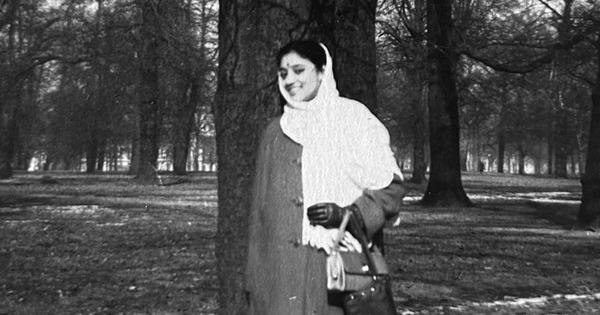
Those days that I have left behind – “bharā thāk smritir sudhāy” (“let them remain full of memory’s nectar”). But all my memories were not, after all, nectar-filled. Casting a net into the river of memories, I can see so many fragments of both happiness and sorrow. So many memories have also perhaps been lost in the river of time – can anyone even try to retain them all? Now, having arrived at my life’s last horizon, I thought that I should perhaps thread my memories into a garland before they’re lost forever. These stories may become a source of joy in the future for my son, my daughter-in-law, my granddaughter. The events of this insignificant ordinary life may be invaluable to them, and then these writings from an unpractised hand may become filled with significance.
I was born in Sibsagar – a district town in Assam. My father had what was, in those days was a world-renowned title – “Engineer” – and, thanks to it, was an officer of rank in what used to be called the Imperial Service in British times. We had a wonderful, large bungalow next to an ocean-like lake. My father had a somewhat fanciful hobby – horse riding – and that hobby was what destroyed us, bringing enormous sorrow into our lives just some time after I was born. The Australian horse that my father had bought so whimsically was apparently really lovely to look at – tan coloured, with a very spirited look about him. The area near his hoofs was as white as the froth on milk, which is why my father fondly named him “Pheni” [from phena, or foam]. I don’t remember Pheni at all, but I have seen him in a group photo of our family. He was standing next to all of us, so tall and imposing looking, and on his back was Chhorda. I don’t know much more than this about Pheni. Because that happy, prosperous, well-off family disappeared like a mirage in an instant.
So many things come to mind – but there’s something I must mention in relation to that group photograph. In those days, it was customary for well-established families to commission a photographer to take family pictures from time to time. Nobody wandered around with a camera hung around their neck like nowadays. These days, there are so many modern gadgets – so many types of Indian and foreign cameras in the market – that any idiot can take the most wonderful pictures. But in those days, photographers went around with a tall three-legged stilt-like wooden stand and their own photo-taking machine. That machine, or camera, would be placed on this high wooden stand, and then they would adjust the focus by covering their head and it with a black cloth. Preparations for the photo would take all day on the day it was to be taken. Firstly, everyone wore their very best outfits. Preferably, the clothes needed to be dark-coloured – that light-coloured clothes don’t make for good photos is an idea common to people these days as well – there’s not much difference where that’s concerned.
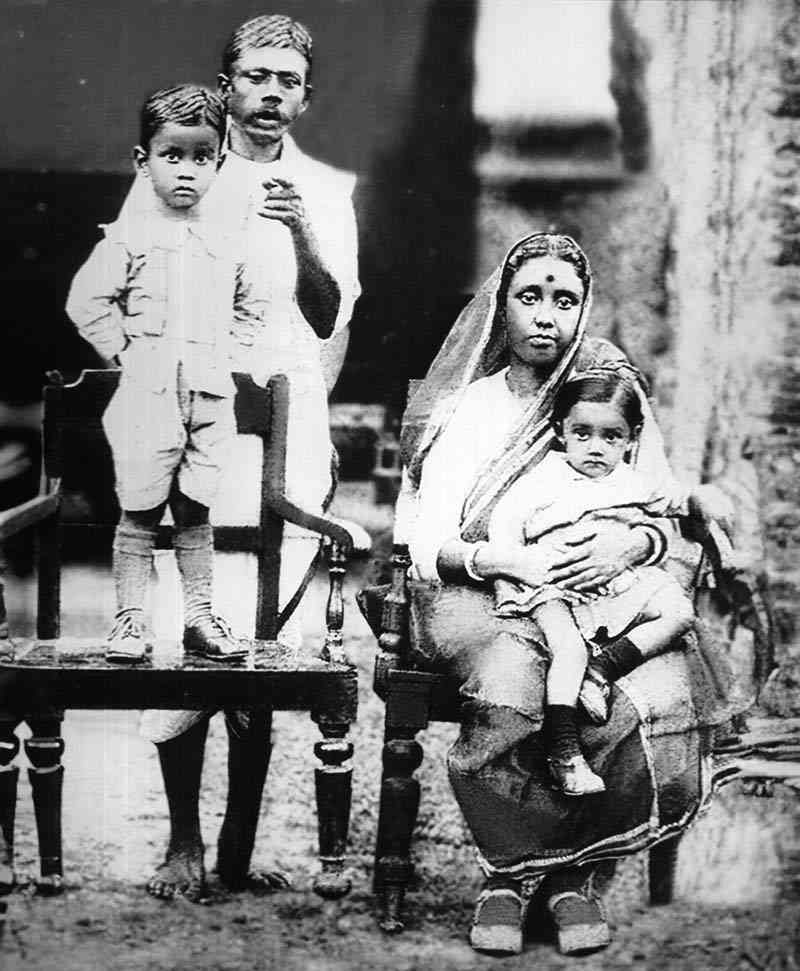
Bijoya Chaudhuri on her mother Sailabala Nandi Majumdar’s lap. Next to them is her brother Radhes, with house help Lakshman, 1927.
Ma would wear a deep blue nīlāmbarī sari – that is what she mostly dressed in for photographs. Everyone sat on rows of chairs. All my brothers wore shoes and socks and dressed up in alpaca-material clothes, and in the middle were my parents. On one side was our horse, Pheni, with Chhorda on his back, and on the other side was our old servant, Lakshman. My father wore a half-sleeved shirt and half-pants, what we nowadays call shorts, with his pith helmet (śolār tupi) perched jauntily on his knee. I have seen this image of my father in many photos. And will I be able to describe my mother’s calm beauty here? Her agile face had the most wonderfully calm and motherly gaze emanating from her large eyes. Hair parted in the middle, pulled back in gentle waves from her forehead and tied into a bun. She wore a three-quarter sleeve blouse or jacket, with a long gold muff chain hanging from her neck. On her feet were closed shoes made of deer skin. I have heard that those shoes were frightfully expensive, and, on the good side, were soft as cotton wool. Such shoes would perhaps put even the shoes at Bombay’s Taj Mahal Hotel’s Joy Shoes to shame. The reason I mention the shoes is because my own feet are extremely sensitive to touch after they were run over by the wheels of a car in my childhood, weakening them for life. I buy shoes with a lot of thought. Looking at the shoes on my mother’s feet, I have always thought, Oh I wish I could buy shoes like that! Anyway, the photo would need to be taken before sundown, because as far as I know, the flash had still not come into use then. The astonishingly beautiful blue silk sari my mother had – soft as a bird’s feathers – was something I also saw later on when I was a little older.
The sari used to be stored in a large trunk then, not adorning her body anymore. After becoming a widow before her time, my mother, although she was so highly educated, blamed herself or her fate for her situation. Which is why she neglected herself for no reason, and tortured herself endlessly. Fasting without water on ekādaśī days, keeping all the strictest rules of the ambubācī without a moment’s hesitation, and all this despite the fact that she was actually a girl from a Brahmo family. There is so much more to say about my mother, but I will do so later. I am suddenly reminded of a completely different beautiful episode related to my mother’s saris that is part of my memory even today. In my childhood, the boys of our locality would “do theatre” from time to time. A stage made of bamboo would be quite readily built in some neighbour’s house with a large courtyard. These stages weren’t fancy like contemporary ones, but there was no dearth of excitement and eagerness put into them. Those who were given parts to play would work hard and put all their hearts into it – memorising their parts somewhat like the preparations nowadays for Secondary and Higher Secondary school exams. Rehearsals would go on for days. Chandragupta, Raja Harishchandra, Karna-Arjun etc and some of Rabindranath’s shorter plays were popular with everyone. All the houses in the neighbourhood would be raided for the various things necessary for the staging – wigs were needed for the female roles. Those I think were available in the market, because in those days nobody had wigs in their homes – I’d never seen anyone come and ask for one in our home.
The one “priceless” thing that they would frequently come to our house for was one of Ma’s saris – that sari was sea-blue in colour, so you couldn’t deny that it really was required in order to depict a river on the stage. Rehearsals for how to show water on the stage were held in our house itself, and I used to watch them open-mouthed while they practised. The whole thing must have been deeply attractive to me, because I haven’t forgotten a single detail, I can still see it clearly before my eyes.
Two boys would stand on two sides holding each end of the sari and they would move it up and down to show the dancing of the waves. I saw the scene of the waves unfold on the stage on the day the play was performed as well. Although I was very little, as far as I remember, to my eyes it didn’t seem like waves in the water. But imagination has no limits, so everyone must have added some colour to their imaginations and actually seen the waves in the river there. I would wait for a long time to see that scene – I think the entire audience enjoyed it very much. There was one other scene that was very astonishing to me. A beautifully dressed girl would slowly come down from the sky and reveal herself before all – she was supposed to be the river Ganga descended from Bhagirath. Although we knew her to be Jhunu-di, we still thought she was some ethereal beauty that had come down from the heavens as a goddess. My inexperienced eyes never actually saw that she was being slowly lowered down a ropeway while seated on a small plank turned into a swing. She would stand quite still right at the centre of the empty stage for some time and the curious audience would wait endlessly for this scene. Everyone would crane their necks to look over other people’s heads, or through the gaps between shoulders to watch this spectacle somehow or the other before the drop scene came down. An explosion of clapping would burst out from the audience. There was also a great demand for song and dance in this kind of neighbourhood theatre. I especially recall “Megherā dal bendhe jāy kon deśe” [“Which land does this band of clouds travel to?”] – we had danced to it in a group, wearing scarves (ornās) of many colours, singing all the while. I never had the chance to learn dance properly, but that was also the time when I was initiated into learning singing.
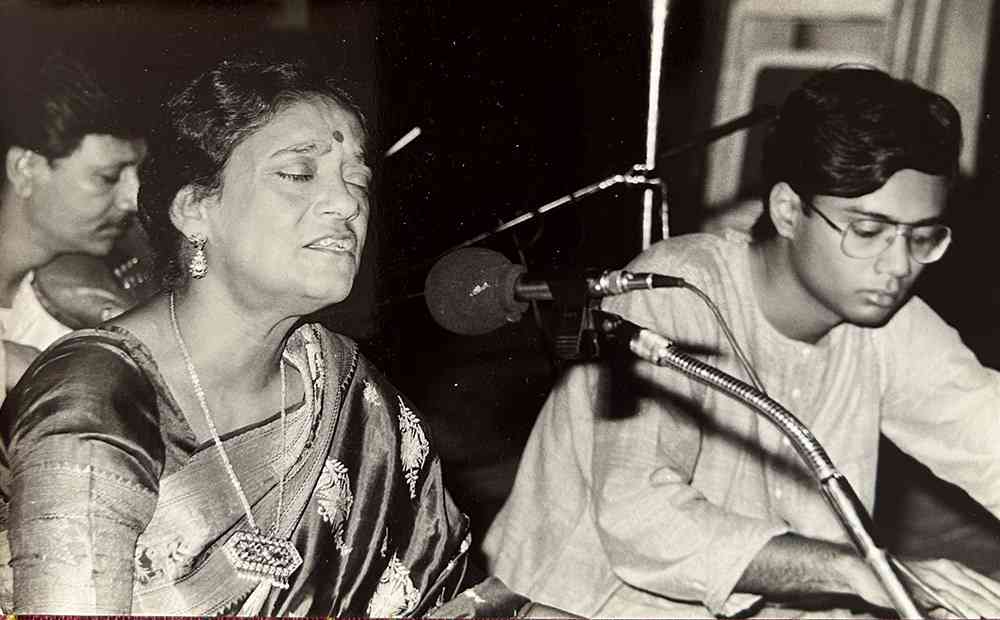
Bijoya accompanied by her son Amit on the harmonium, Babulal Gandharva on bela bahar behind her.
I was born with a natural ability to sing. All of us brothers and sisters had the ability to sing, almost as soon as we learnt how to talk. Some of us had excellent voices – such as Sejda. In my childhood, my younger brother and I had our first singing lessons from him. I heard later from my mother that as long as my father was alive, he had to sing in secret. My father was absolutely certain that if his sons spent time in music or singing they would never be able to study, they wouldn’t become engineers. But our father vanished long before any of us grew up. And we pursued our music and song with deep dedication. Writing about the neighbourhood plays reminds me of something else. Something happened when I was a child that hurt me so deeply that I have never forgotten it completely. A play was about to be performed, and rehearsals were proceeding apace for the last few days. As far as I remember, the play that had been chosen was “The Fall of Mewar”, and Sejda was going to be singing one of the songs – “E path geche konkhāne go” [“Oh where does this path go to”]. The plays used to be performed a little late at night.
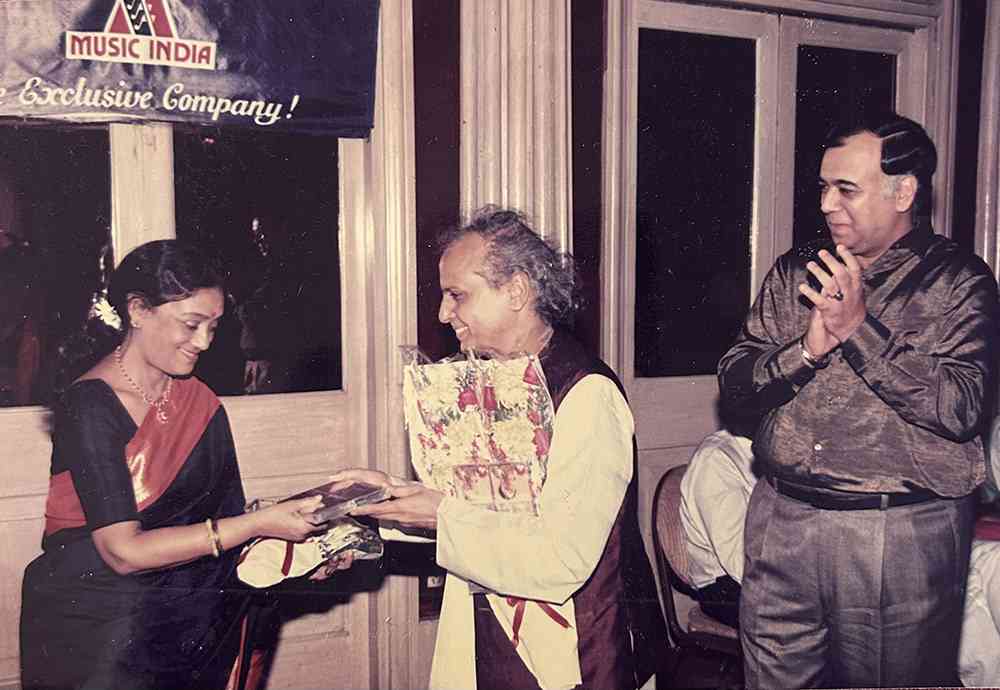
Pandit Jasraj releases Bijoya Chaudhuri’s album of bhajans, Bhakti Gunjan, 1988. On the right is Music India’s Vijay Lazarus.
The women of the house would come to watch these plays after having finished their dinner and all their household work. I was lying on the bed in the evening and watching everyone, all very busy as they went about their tasks. My sleepy eyes were closing of their own accord from time to time, but I was trying very hard to keep them open, because we had to go and watch the play in a little while. I was quite sure that I was awake, and that I would remain awake, but treacherous sleep came to my eyes with such force that I forgot everything and fell into a deep sleep. I have no idea how late in the night it was when I suddenly started up from my sleep and jolted awake. In the dim light of the lantern I saw Lakshman lying on the ground. As soon as I woke up I began to cry for my mother. Far away I could hear the sound of singing and dancing, and more specifically, it seemed I could faintly hear Sejda’s singing. My continuous wailing woke Lakshman up. “Khuki shona, don’t cry, don’t cry” he said, trying to calm me down. But who was listening to him, I went on crying. Everyone came home late at night, full of revelry and laughter, and seeing my tears they all began to take turns to try and calm me down. The next morning, I began to cry again and one of my brothers picked me up and took me out for a little walk. I was reassured that the play would be performed again very soon, and this time, I would definitely see it. But the play was never staged again, and the sorrow of not having seen it stayed in my mind like a thorn for a long time.
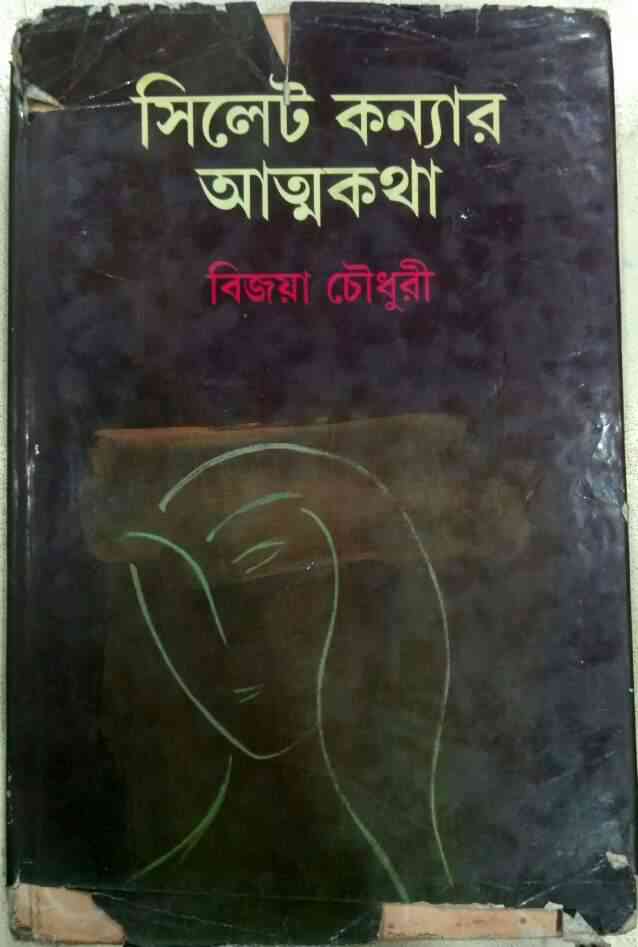
This excerpt from Sylhet Konyar Atmakatha, published in 2004 by Anustup, has been translated from the Bengali by Rosinka Chaudhuri.
